Skip to content
Decoratoradvice

Decoratoradvice

Where only the best advice will suffice!

  • Home
  • Decorate Your Home
  • Home Exterior
  • Home Tips & Guides
  • About Us
  • Contact Us
Watch Online

From Front Door to Driver’s Seat: Designing a Seamless Everyday Experience

Abbukkhar Kangharnnia May 7, 2026 5 min read
37
From Front Door to Driver’s Seat: Designing a Seamless Everyday Experience

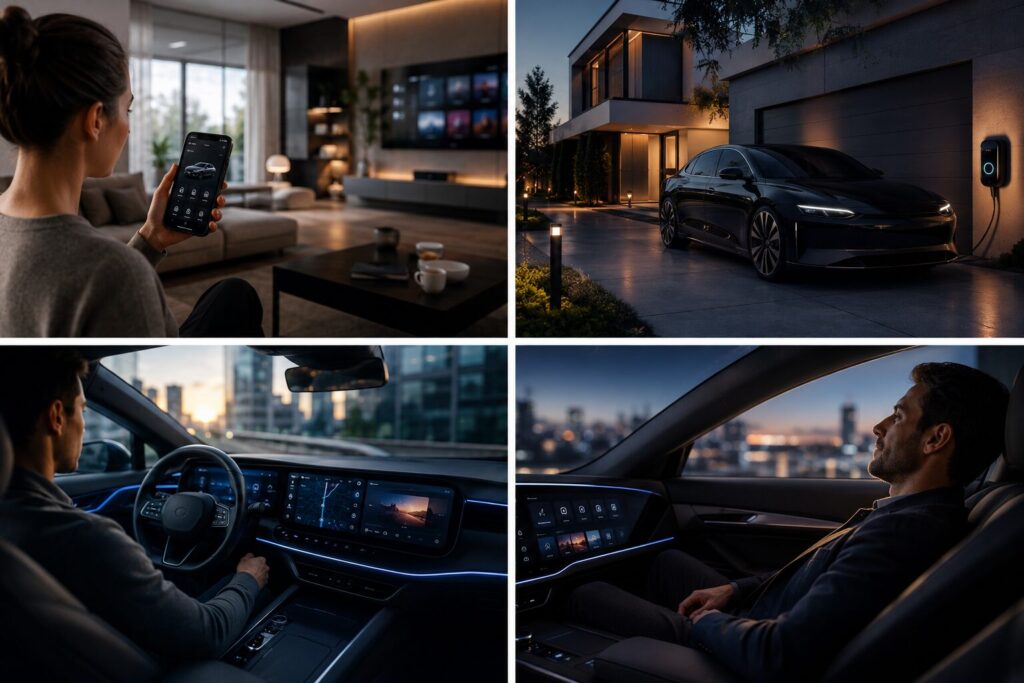
The modern commute rarely begins when the engine starts. It begins much earlier—in the hallway, the kitchen, or even on a phone screen while still inside the house. As daily life becomes increasingly shaped by connected devices and automated systems, the boundary between home and car is quietly dissolving.

What used to be two separate environments—domestic space and driving space—are now being rethought as a continuous experience. Designers, architects, and automotive engineers are beginning to ask the same question: what does a truly seamless transition between home and vehicle actually look like?

The End of Fragmented Movement

For decades, the journey from home to car was treated as a simple physical transition. You left one environment, entered another, and adapted accordingly. The house was warm, static, and private; the car was mechanical, functional, and temporary.

That distinction is becoming less relevant. Smart homes now pre-condition heating, lighting, and even security systems based on routines. At the same time, vehicles are increasingly aware of driver behaviour, schedules, and preferences. The result is a growing overlap between the two environments.

A morning routine might now involve your home adjusting lighting as your alarm ends, while your car pre-cools or pre-heats itself based on your calendar. The journey is no longer a break in experience—it is a continuation of it.

Designing for Transition, Not Just Spaces

Traditionally, design disciplines treated home interiors and vehicle interiors as separate worlds. Architecture focused on permanence; automotive design focused on motion. But that divide is becoming less useful.

Today, both environments are converging around the idea of user experience. In homes, this is visible in the rise of voice assistants, automated lighting scenes, and integrated entertainment systems. In cars, it appears in digital dashboards, personalised profiles, and connected infotainment ecosystems.

The interesting shift is not just technological, but behavioural. Designers are increasingly thinking in terms of transitions—how a person moves between contexts without friction. This includes physical movement (walking out of a home and into a car), but also cognitive continuity (keeping preferences, routines, and digital identity intact).

The goal is not uniformity, but coherence.

The Car as a Second Living Space
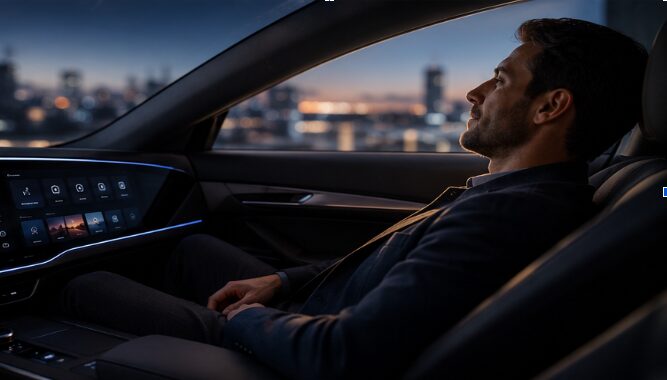
Modern vehicles are no longer purely transport tools. Especially in urban environments, they function as semi-personal spaces—places where people make calls, consume media, or briefly disconnect from their surroundings.

This shift has influenced interior design significantly. Seating comfort, ambient lighting, noise insulation, and screen placement are now considered as carefully as engine performance or fuel efficiency. In electric vehicles, where engine noise is minimal, interior experience becomes even more central.

In many ways, the car is becoming an extension of the living room—just one that moves through space.

This raises interesting design challenges. Unlike homes, cars must adapt to constant motion, changing light conditions, and strict safety requirements. Yet expectations from users continue to rise, shaped by the seamless interfaces they already experience in domestic technology.

Identity Across Environments

One of the more subtle changes in this home-to-car continuum is the role of identity. People increasingly expect continuity in how they present themselves across different environments.

This is visible in small but meaningful ways: synced playlists between home speakers and car systems, personalised seating positions, or preferred driving modes that activate automatically. Even visual customisation plays a role, as drivers seek consistency between their personal style and their vehicle’s appearance.

Personalisation has also extended into exterior design choices, where small details contribute to a sense of ownership and identity. For some drivers, even elements like registration styling become part of this expression. Companies such as Number 1 Plates operate within this space, reflecting a broader demand for vehicles that feel individually tailored rather than mass-produced.

The key point is not the object itself, but the desire for continuity—across home, device, and vehicle.

The Role of Digital Ecosystems

At the centre of this seamless experience is software. Connected ecosystems now link homes, phones, and cars into a single network of preferences and data.

This ecosystem approach allows for predictive behaviour. A car might suggest leaving earlier due to traffic conditions, while a home might adjust energy usage based on departure time. Calendar integration, location tracking, and machine learning all contribute to reducing friction in daily routines.

However, this integration also introduces complexity. The more systems communicate with each other, the more important questions of control, privacy, and transparency become. Users are no longer interacting with isolated products, but with interconnected environments that respond to their behaviour.

Designing for this reality requires more than technical capability—it requires restraint. The most effective systems are often the ones that feel invisible.

The Psychology of Smooth Transitions

Beyond technology, there is a psychological dimension to this shift. Humans tend to prefer continuity in routine. Abrupt changes between environments can create small but noticeable cognitive load, especially during early mornings or busy schedules.

A seamless transition from home to car reduces this friction. Familiar interfaces, consistent lighting tones, and predictable interactions help maintain a sense of stability.

This is why design consistency is becoming so important across industries. Whether it is a thermostat, a smartphone, or a dashboard interface, users are increasingly drawn to systems that behave in expected ways.

The future of design may not be about creating more features, but about reducing the effort required to move between them.

Rethinking the Commute

As home and car become more connected, the idea of the commute itself is changing. Instead of being a disconnected segment of the day, it is becoming part of a continuous flow of activity.

For some, this means productivity extending into travel time. For others, it means better separation between work and rest through automated environmental shifts. Either way, the boundary is no longer fixed.

Urban planning, automotive design, and residential architecture are beginning to reflect this shift, even if subtly. The challenge ahead is ensuring that this integration enhances daily life rather than complicates it.

Conclusion

The transition from front door to driver’s seat is no longer just a physical movement—it is an experience shaped by design, technology, and expectation. As homes and cars become increasingly connected, the focus is shifting toward creating continuity across environments rather than treating them as separate worlds.

The most successful designs in this space are unlikely to be the most complex. Instead, they will be the ones that quietly remove friction, allowing people to move through their day without interruption or adjustment.

In that sense, the future of mobility is not just about how we travel—but how seamlessly we live while doing it.


Post navigation

Previous Ways to Take Care of Aerial Work Platforms for Longevity and Smooth Operation
Next Popular Home Design Marketing Trends Shaping 2026

Trending

Popular Home Design Marketing Trends Shaping 2026 Popular Home Design Marketing Trends Shaping 2026 1

Popular Home Design Marketing Trends Shaping 2026

May 8, 2026
From Front Door to Driver’s Seat: Designing a Seamless Everyday Experience From Front Door to Driver’s Seat: Designing a Seamless Everyday Experience 2

From Front Door to Driver’s Seat: Designing a Seamless Everyday Experience

May 7, 2026
Ways to Take Care of Aerial Work Platforms for Longevity and Smooth Operation Ways to Take Care of Aerial Work Platforms for Longevity and Smooth Operation 3

Ways to Take Care of Aerial Work Platforms for Longevity and Smooth Operation

May 7, 2026
What to Look for in a Stucco Contractor in Calgary for Durable Exterior Finishes What to Look for in a Stucco Contractor in Calgary for Durable Exterior Finishes 4

What to Look for in a Stucco Contractor in Calgary for Durable Exterior Finishes

May 6, 2026
How Window Styles Shape the Character of a Room How Window Styles Shape the Character of a Room 5

How Window Styles Shape the Character of a Room

May 6, 2026
Stylish and Durable Basement Flooring Ideas Stylish and Durable Basement Flooring Ideas 6

Stylish and Durable Basement Flooring Ideas

May 6, 2026

Related Stories

Ways to Take Care of Aerial Work Platforms for Longevity and Smooth Operation Ways to Take Care of Aerial Work Platforms for Longevity and Smooth Operation
3 min read

Ways to Take Care of Aerial Work Platforms for Longevity and Smooth Operation

May 7, 2026 39
What Happens Before Landscaping, Patios, or New Outdoor Features Are Built What Happens Before Landscaping, Patios, or New Outdoor Features Are Built
4 min read

What Happens Before Landscaping, Patios, or New Outdoor Features Are Built

May 3, 2026 59
Storm Shutters vs. Impact Windows: Pros, Cons, and What South Florida Homeowners Should Choose Storm Shutters vs. Impact Windows: Pros, Cons, and What South Florida Homeowners
Should Choose
5 min read

Storm Shutters vs. Impact Windows: Pros, Cons, and What South Florida Homeowners Should Choose

May 1, 2026 349
10 Fire Safety Essentials Every Home Should Have in 2026 10 Fire Safety Essentials Every Home Should Have in 2026
2 min read

10 Fire Safety Essentials Every Home Should Have in 2026

April 30, 2026 74
Ireland Workspace Trends 2026: Why Shelving, Lockers & Standing Desks Are in High Demand Ireland Workspace Trends 2026: Why Shelving, Lockers & Standing Desks Are in
High Demand
3 min read

Ireland Workspace Trends 2026: Why Shelving, Lockers & Standing Desks Are in High Demand

April 30, 2026 78
Creative Games Room Setups to Try at Home with a Black Flat Screen TV Creative Games Room Setups to Try at Home with a Black Flat Screen TV
3 min read

Creative Games Room Setups to Try at Home with a Black Flat Screen TV

April 29, 2026 90

you may like

Popular Home Design Marketing Trends Shaping 2026 Popular Home Design Marketing Trends Shaping 2026
4 min read

Popular Home Design Marketing Trends Shaping 2026

Avedyn Phytes May 8, 2026 23
Home design in 2026 is about more than beautiful interiors. It is about how spaces are experienced,...
Read More
How to Compare Different Color Palettes in Interior Design How to Compare Different Color Palettes in Interior Design

How to Compare Different Color Palettes in Interior Design

May 6, 2026
Critical Warning Signs That Demand Emergency Chimney Repair Critical Warning Signs That Demand Emergency Chimney Repair

Critical Warning Signs That Demand Emergency Chimney Repair

April 28, 2026
How to Choose a Quality Washable Rug: A Practical Guide to Shop at Ruggable How to Choose a Quality Washable Rug: A Practical Guide to Shop at Ruggable

How to Choose a Quality Washable Rug: A Practical Guide to Shop at Ruggable

April 28, 2026
How to design a professional gaming room How to design a professional gaming room

How to design a professional gaming room

April 25, 2026

Thanks to our partners!


CasinoFrog
  • Home
  • Privacy Policy
  • Terms & Conditions
  • About Us
  • Contact Us
© 2026 decoratoradvice.com | Powered by DecoratorAdvice | 501 7th Avenue, New York NY 10018
We use cookies on our website to give you the most relevant experience by remembering your preferences and repeat visits. By clicking “Accept”, you consent to the use of ALL the cookies.
Do not sell my personal information.
Cookie SettingsAccept
Manage consent

Privacy Overview

This website uses cookies to improve your experience while you navigate through the website. Out of these, the cookies that are categorized as necessary are stored on your browser as they are essential for the working of basic functionalities of the website. We also use third-party cookies that help us analyze and understand how you use this website. These cookies will be stored in your browser only with your consent. You also have the option to opt-out of these cookies. But opting out of some of these cookies may affect your browsing experience.
Necessary
Always Enabled
Necessary cookies are absolutely essential for the website to function properly. These cookies ensure basic functionalities and security features of the website, anonymously.
CookieDurationDescription
cookielawinfo-checkbox-analytics11 monthsThis cookie is set by GDPR Cookie Consent plugin. The cookie is used to store the user consent for the cookies in the category "Analytics".
cookielawinfo-checkbox-functional11 monthsThe cookie is set by GDPR cookie consent to record the user consent for the cookies in the category "Functional".
cookielawinfo-checkbox-necessary11 monthsThis cookie is set by GDPR Cookie Consent plugin. The cookies is used to store the user consent for the cookies in the category "Necessary".
cookielawinfo-checkbox-others11 monthsThis cookie is set by GDPR Cookie Consent plugin. The cookie is used to store the user consent for the cookies in the category "Other.
cookielawinfo-checkbox-performance11 monthsThis cookie is set by GDPR Cookie Consent plugin. The cookie is used to store the user consent for the cookies in the category "Performance".
viewed_cookie_policy11 monthsThe cookie is set by the GDPR Cookie Consent plugin and is used to store whether or not user has consented to the use of cookies. It does not store any personal data.
Functional
Functional cookies help to perform certain functionalities like sharing the content of the website on social media platforms, collect feedbacks, and other third-party features.
Performance
Performance cookies are used to understand and analyze the key performance indexes of the website which helps in delivering a better user experience for the visitors.
Analytics
Analytical cookies are used to understand how visitors interact with the website. These cookies help provide information on metrics the number of visitors, bounce rate, traffic source, etc.
Advertisement
Advertisement cookies are used to provide visitors with relevant ads and marketing campaigns. These cookies track visitors across websites and collect information to provide customized ads.
Others
Other uncategorized cookies are those that are being analyzed and have not been classified into a category as yet.
SAVE & ACCEPT