From Front Door to Driver’s Seat: Designing a Seamless Everyday Experience
 Abbukkhar Kangharnnia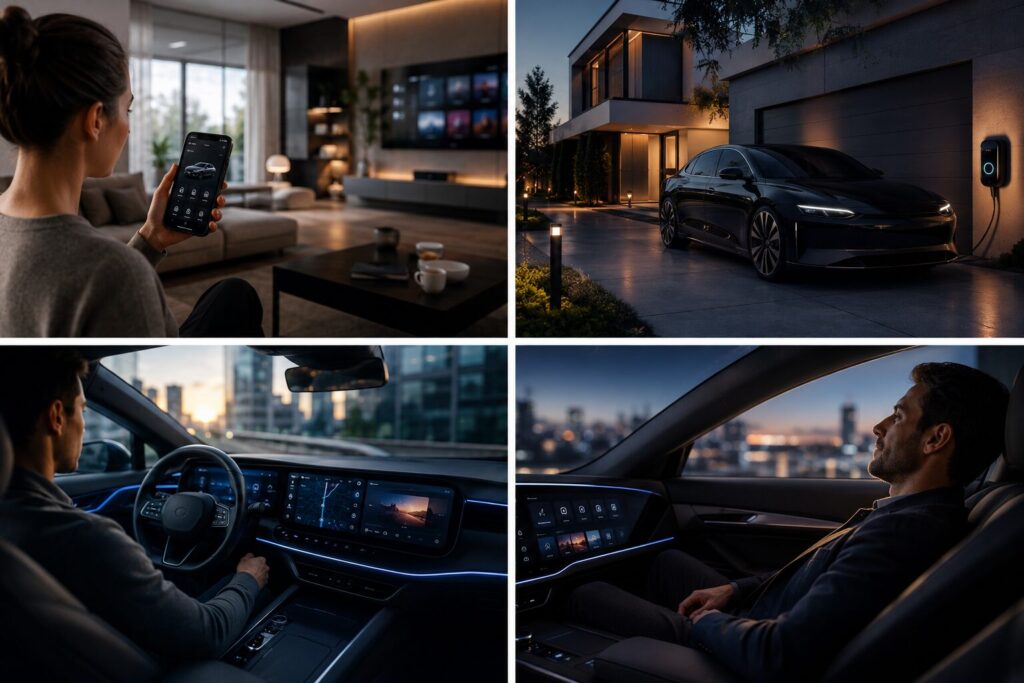
The modern commute rarely begins when the engine starts. It begins much earlier—in the hallway, the kitchen, or even on a phone screen while still inside the house. As daily life becomes increasingly shaped by connected devices and automated systems, the boundary between home and car is quietly dissolving.
What used to be two separate environments—domestic space and driving space—are now being rethought as a continuous experience. Designers, architects, and automotive engineers are beginning to ask the same question: what does a truly seamless transition between home and vehicle actually look like?
The End of Fragmented Movement
For decades, the journey from home to car was treated as a simple physical transition. You left one environment, entered another, and adapted accordingly. The house was warm, static, and private; the car was mechanical, functional, and temporary.
That distinction is becoming less relevant. Smart homes now pre-condition heating, lighting, and even security systems based on routines. At the same time, vehicles are increasingly aware of driver behaviour, schedules, and preferences. The result is a growing overlap between the two environments.
A morning routine might now involve your home adjusting lighting as your alarm ends, while your car pre-cools or pre-heats itself based on your calendar. The journey is no longer a break in experience—it is a continuation of it.
Designing for Transition, Not Just Spaces
Traditionally, design disciplines treated home interiors and vehicle interiors as separate worlds. Architecture focused on permanence; automotive design focused on motion. But that divide is becoming less useful.
Today, both environments are converging around the idea of user experience. In homes, this is visible in the rise of voice assistants, automated lighting scenes, and integrated entertainment systems. In cars, it appears in digital dashboards, personalised profiles, and connected infotainment ecosystems.
The interesting shift is not just technological, but behavioural. Designers are increasingly thinking in terms of transitions—how a person moves between contexts without friction. This includes physical movement (walking out of a home and into a car), but also cognitive continuity (keeping preferences, routines, and digital identity intact).
The goal is not uniformity, but coherence.
The Car as a Second Living Space
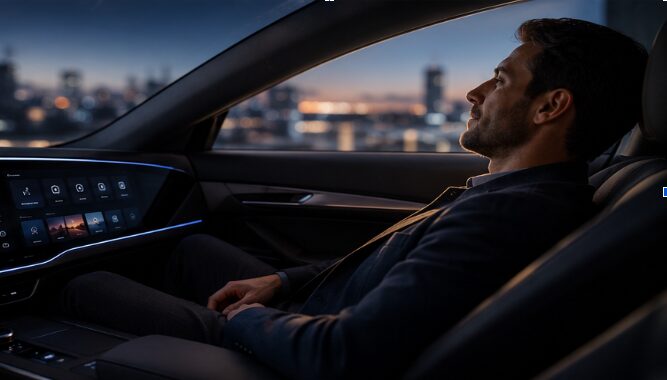
Modern vehicles are no longer purely transport tools. Especially in urban environments, they function as semi-personal spaces—places where people make calls, consume media, or briefly disconnect from their surroundings.
This shift has influenced interior design significantly. Seating comfort, ambient lighting, noise insulation, and screen placement are now considered as carefully as engine performance or fuel efficiency. In electric vehicles, where engine noise is minimal, interior experience becomes even more central.
In many ways, the car is becoming an extension of the living room—just one that moves through space.
This raises interesting design challenges. Unlike homes, cars must adapt to constant motion, changing light conditions, and strict safety requirements. Yet expectations from users continue to rise, shaped by the seamless interfaces they already experience in domestic technology.
Identity Across Environments
One of the more subtle changes in this home-to-car continuum is the role of identity. People increasingly expect continuity in how they present themselves across different environments.
This is visible in small but meaningful ways: synced playlists between home speakers and car systems, personalised seating positions, or preferred driving modes that activate automatically. Even visual customisation plays a role, as drivers seek consistency between their personal style and their vehicle’s appearance.
Personalisation has also extended into exterior design choices, where small details contribute to a sense of ownership and identity. For some drivers, even elements like registration styling become part of this expression. Companies such as Number 1 Plates operate within this space, reflecting a broader demand for vehicles that feel individually tailored rather than mass-produced.
The key point is not the object itself, but the desire for continuity—across home, device, and vehicle.
The Role of Digital Ecosystems
At the centre of this seamless experience is software. Connected ecosystems now link homes, phones, and cars into a single network of preferences and data.
This ecosystem approach allows for predictive behaviour. A car might suggest leaving earlier due to traffic conditions, while a home might adjust energy usage based on departure time. Calendar integration, location tracking, and machine learning all contribute to reducing friction in daily routines.
However, this integration also introduces complexity. The more systems communicate with each other, the more important questions of control, privacy, and transparency become. Users are no longer interacting with isolated products, but with interconnected environments that respond to their behaviour.
Designing for this reality requires more than technical capability—it requires restraint. The most effective systems are often the ones that feel invisible.
The Psychology of Smooth Transitions
Beyond technology, there is a psychological dimension to this shift. Humans tend to prefer continuity in routine. Abrupt changes between environments can create small but noticeable cognitive load, especially during early mornings or busy schedules.
A seamless transition from home to car reduces this friction. Familiar interfaces, consistent lighting tones, and predictable interactions help maintain a sense of stability.
This is why design consistency is becoming so important across industries. Whether it is a thermostat, a smartphone, or a dashboard interface, users are increasingly drawn to systems that behave in expected ways.
The future of design may not be about creating more features, but about reducing the effort required to move between them.
Rethinking the Commute
As home and car become more connected, the idea of the commute itself is changing. Instead of being a disconnected segment of the day, it is becoming part of a continuous flow of activity.
For some, this means productivity extending into travel time. For others, it means better separation between work and rest through automated environmental shifts. Either way, the boundary is no longer fixed.
Urban planning, automotive design, and residential architecture are beginning to reflect this shift, even if subtly. The challenge ahead is ensuring that this integration enhances daily life rather than complicates it.
Conclusion
The transition from front door to driver’s seat is no longer just a physical movement—it is an experience shaped by design, technology, and expectation. As homes and cars become increasingly connected, the focus is shifting toward creating continuity across environments rather than treating them as separate worlds.
The most successful designs in this space are unlikely to be the most complex. Instead, they will be the ones that quietly remove friction, allowing people to move through their day without interruption or adjustment.
In that sense, the future of mobility is not just about how we travel—but how seamlessly we live while doing it.


 Nophyn Tesil


 Gary Cripps