Garage Door Spring Repair: Why Springs Break, What Happens Next, and Why It Is Never a DIY Job
 Abbukkhar Kangharnnia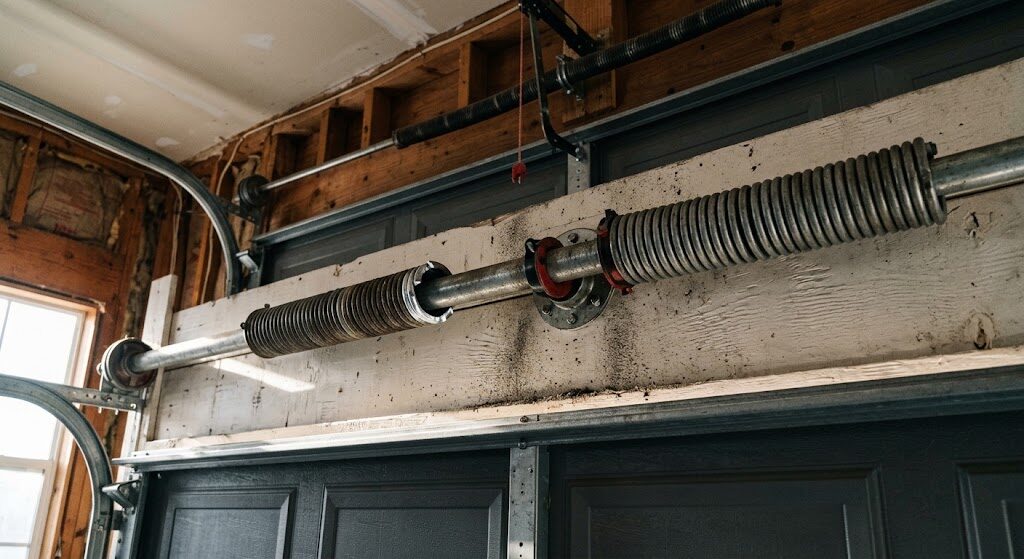
Almost everyone who has owned a house with an attached garage has heard it at least once. A single loud bang from the garage, like something heavy hitting concrete or a rifle going off, and then silence. In the morning the door will not lift and the opener strains against it uselessly.
That is a broken torsion spring, and it is the most common significant garage door failure there is. Here is why it happens, what the warning signs look like, and why this particular repair sits firmly outside the do-it-yourself category.
What the Springs Actually Do
A garage door weighs somewhere between 130 and 400 pounds depending on size, material and insulation. The opener motor is not remotely powerful enough to lift that. What lifts it is the counterbalance system.
Torsion springs, the most common type on modern doors, sit on a steel shaft above the door opening. As the door closes, the springs wind up and store energy. As the door opens, they unwind and release it, turning drums at each end of the shaft that wind up the lift cables attached to the bottom corners of the door. Done correctly, the spring tension almost exactly offsets the weight of the door, which is why a properly balanced door can be lifted by hand with modest effort.
Extension springs are the older arrangement, mounted along the horizontal tracks on either side and stretching as the door closes. They are found on lighter and older doors and should always be fitted with safety containment cables running through them.
Either way, the springs are doing all the work. The opener is just a guide.
Why They Break
Springs are rated in cycles, not years. One cycle is one full open and one full close. A standard spring is rated for roughly 10,000 cycles.
For a household that opens the door four times a day, that works out to around seven years. For a busy household running in and out eight or ten times a day, it is three or four. This is why two identical doors installed on the same street in the same year can fail five years apart.
Cold accelerates it. Steel contracts in low temperatures and a spring near the end of life will very often choose the coldest week of the year to fail. Corrosion accelerates it too, which is why coastal properties and garages that see road salt run through springs faster.
Heavy-duty springs rated at 25,000 to 50,000 cycles are available and cost modestly more. For a busy household they are usually the better purchase, and it is worth asking about them at the point of replacement.
The Warning Signs
Springs rarely fail without notice, though the notice is easy to miss.
The door becomes heavy. With the opener disconnected, a balanced door should stay roughly where you leave it at waist height. One that sinks or drops has weakening springs.
The opener strains, hums, or works visibly harder than it used to. It may raise the door a foot and then reverse.
The door opens jerkily or in stages rather than smoothly.
And the most visible sign of all: a gap in the spring coil. A torsion spring is a continuous tight coil. If you can see a two-inch gap partway along it, the spring has already broken.
Why This One Is Not a DIY Job
There is a large volume of online content suggesting spring replacement is within reach of a competent homeowner. It is not, and the reason is stored energy rather than complexity.
A wound torsion spring holds an extraordinary amount of energy in a small space. Releasing it in a controlled way requires correctly sized winding bars and a specific technique. Using a screwdriver or a piece of rebar instead, which is what people reach for, is how the bar becomes a projectile and how hands get caught. Injuries from amateur spring work are consistently severe rather than minor.
There is also a specification problem. Springs are matched to door weight, height and drum size, and fitting the wrong wire gauge or length produces a door that is unbalanced from day one, which then destroys the opener and wears the cables. Getting this right requires actually weighing the door.
Professional garage door spring repair is typically a 60 to 90 minute job, and the correct approach includes checking the cables, drums, bearings, rollers and hinges at the same time, since a spring failure often damages the components around it.
Replace in Pairs
One point that is worth insisting on. If the door has two springs and one has broken, both should be replaced.
They were installed together, they have been through the same number of cycles, and the second one is statistically very close behind the first. Replacing only the broken one means paying a second call-out fee within the year, and running an unmatched pair in the meantime, which loads the assembly unevenly.
What to Do Right Now if One Has Just Broken
Stop using the opener. Repeated attempts to lift a door with a broken spring strain the motor and can pull the door off its tracks or damage the remaining cable.
Do not try to lift the door by hand either. Without spring assistance you are lifting the full weight, and if it gets away from you it comes down hard.
If the door happens to be stuck in the open position, keep everyone clear of the opening entirely, including pets, and do not walk under it.
Then make the call. A broken spring is a same-day repair for most companies, and it is not a job that improves with waiting.


 Avedyn Phytes